
The First Evolution: Automation
For years, technology has helped surrogacy and egg donation agencies automate repetitive work: If this happens, do that.
When an application is submitted, send an email. When a surrogate reaches a certain stage, create a task. When a status changes, notify a team member.
The Second Evolution: Generative AI
Automation has been enormously valuable. But there has always been one fundamental limitation: we have to tell the computer exactly what to do. Generative Artificial Intelligence, or GenAI, is changing that relationship.
From Following Instructions to Understanding Intent
Traditional computing requires precise instructions. We tell the computer what conditions to look for and exactly what should happen when those conditions are met.
Generative AI works differently. Through natural language, we can describe what we want to accomplish rather than programming every step required to accomplish it. Instead of creating dozens of rules, we can simply say:
“Review this surrogate lead. Identify eligibility concerns, missing information, and follow-up needed.”
The AI can analyze the information, interpret the request, and generate a response. That ability to work with intent and context rather than only predetermined conditions represents an important change in how we interact with technology.
The Next Evolution: AI Agents
Now we are moving into the next evolution: AI Agents.
An AI Agent generally uses GenAI as its intelligence and puts that intelligence to work performing a specific job. Think of an AI Agent as a very capable digital assistant that has been given a job to do. A chatbot generally waits for a question and provides an answer.
An AI Agent can be given an objective, access to relevant information, and instructions about the job it is expected to perform. Depending on how it is configured, it can review information, identify issues, retrieve additional information, make recommendations, and even use authorized tools to take certain actions.
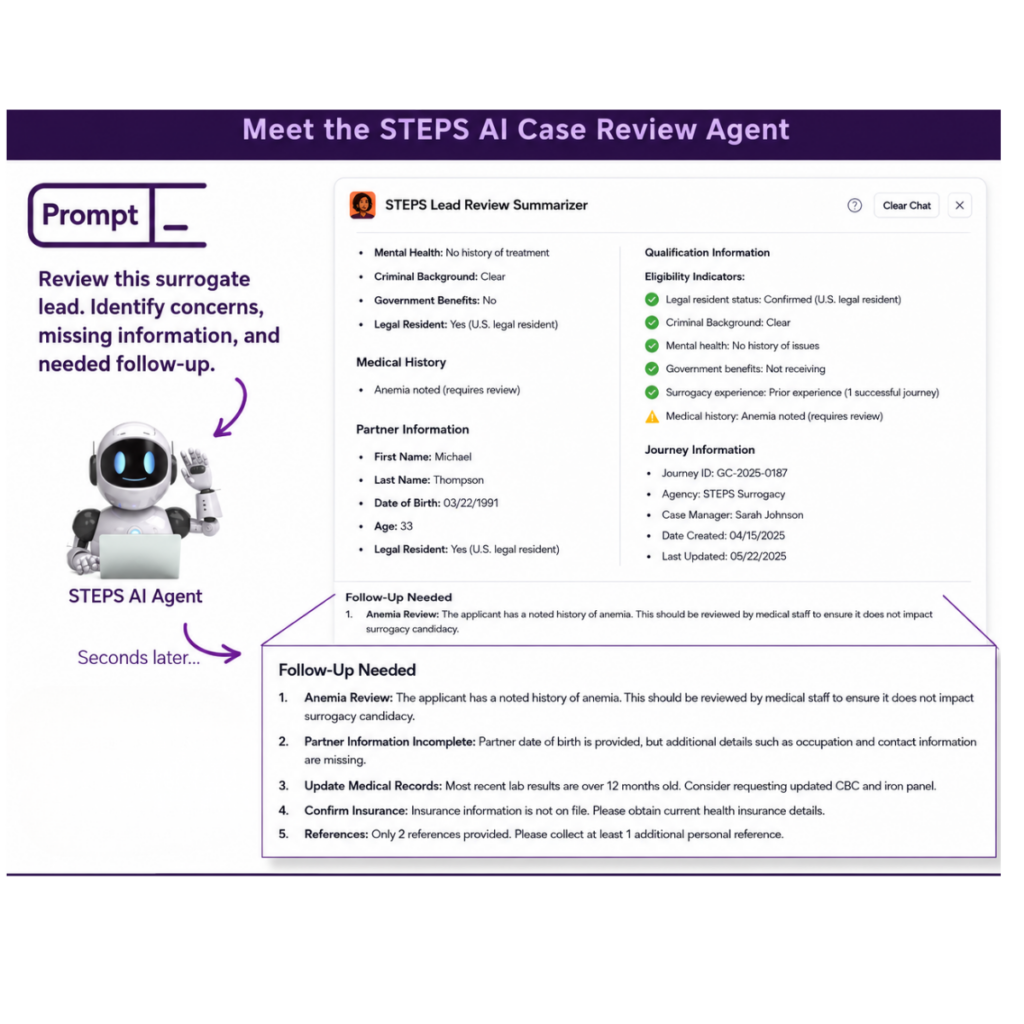
Now, when I asked the AI Agent the same question as above:
“Review this surrogate lead. Identify eligibility concerns, missing information, and follow-up needed.”
The Agent provided a summary of the record. But it did something else that was particularly interesting. It identified that the applicant had reported a history of anemia and recommended that it be reviewed.
I never programmed the Agent to look for anemia.
I told it which information, or fields within the CRM, it could review and what I wanted it to accomplish. It recognized something potentially relevant within that information and brought it to my attention. That is fundamentally different from traditional automation.
Had I built a conventional workflow, I would have needed to anticipate anemia as a condition and specifically program:
If anemia = Yes → flag for review.
GenAI can generate an answer. An AI Agent puts that intelligence to work toward a defined objective.
The professional still determines whether the information is important and what should happen next. But the Agent can help make sure the professional sees it.
That opens up enormous possibilities for our field.
What Is STEPS?
STEPS is a comprehensive CRM that we built specifically for surrogacy and egg donation agencies.
Built on Zoho One, STEPS brings an agency’s intended parents, surrogates and egg donors, intake, matching, case management, financials, insurance, documents, communications, reporting, and other day-to-day operations together within one customizable system.
Each STEPS CRM is 100% owned by the Agency and customized around how that particular agency operates.
And now, AI Agents can work directly within that environment.
Imagine Giving Every Team Member an Assistant
The Case Review Agent is only the beginning. Imagine Agents that assist with intake review, missing documentation, match readiness, insurance follow-up, journey milestones, case summaries, or management reporting.
Imagine having an Agent compare a GC and an IP record and identify where they are similar or different. It could review their preferences regarding contact before, during, and after birth; their views on termination; the number of embryos to transfer; or other important matching considerations.
Or imagine a case manager being able to ask:
“What is still missing from this case?”
Instead of searching through dozens of fields, notes, documents, and records, an Agent could review the information it has been authorized to access and identify what needs attention. The possibilities are enormous.
AI Agents can assist with work where every situation does not fit neatly into a predetermined set of rules. The professional still makes the decisions. But now, every member of your team can have a very capable assistant working alongside them.
And as agencies begin using AI this way, I believe we need to start asking a much bigger question:
What Happens to Your Agency’s Institutional Knowledge?
Every established agency possesses something extraordinarily valuable that rarely appears on a balance sheet:
Institutional knowledge.
It is the experience accumulated over years by the people within an organization:
- An experienced case manager knows which questions to ask.
- An experienced intake coordinator recognizes something in an application that deserves a second look.
- An experienced agency owner knows which issues frequently create problems months later in a journey.
Historically, much of this knowledge has lived inside people’s heads. When experienced employees leave, some of that knowledge inevitably leaves with them. AI gives us an opportunity to change that. Over time, an agency can incorporate more of its criteria, procedures, policies, and accumulated experience into its AI Agents. The Agent can become another place where the organization’s knowledge resides.
That transforms the conversation from simply using AI to something much more significant: Building institutional intelligence. And that raises another important question:
Who owns it?
Using an App Is Not the Same as Owning Your Technology
Most of us use apps every day without thinking very much about who owns them. But there is an important distinction between using someone else’s application and building a technology asset around your own organization. When you subscribe to an application, you are using a product owned and controlled by another company.
You may spend years entering data, configuring processes, training employees, and building your operations around that software. But you don’t control the company behind it.
What happens if that company goes out of business or is sold?
A new owner can change the pricing.
- It can change features.
- It can change the direction of the product.
- It can change integrations or its AI strategy.
- It could merge the application into another product or eventually discontinue it altogether.
Your agency may have spent years becoming dependent upon that application, yet have very little influence over those decisions. When all you are renting is software, losing control of the application is concerning.
When that application also contains years of your agency’s processes, criteria, and institutional knowledge, the stakes become considerably higher.
AI makes the issue of ownership more important than ever.
Are You Building Your Intelligence or Someone Else’s?
With traditional software, agencies primarily placed their data into somebody else’s application. With AI, we may begin placing something even more valuable into technology:
- How an agency opetates..
- What makes a good surrogate candidate?
- What issues should trigger additional review?
- What does your agency consider an acceptable exception?
- What commonly goes wrong during a journey?
- What should staff look for before matching?
- What questions should be asked when certain circumstances arise?
Those aren’t simply data points. They represent the accumulated knowledge and experience of an organization.
As companies begin offering AI tools to multiple agencies, agency owners should understand exactly how those systems work. Ask questions:
- Where does our agency’s information go?
- What information can the AI access?
- Is our data isolated from that of other agencies?
- Are the Agent’s instructions and knowledge specific to our organization?
- Who owns the Agents we develop?
- What happens to those Agents and their configurations if we leave the provider?
- What happens if the company providing the technology is sold?
Perhaps the most important question is:
Am I building my agency’s intelligence, or am I helping build someone else’s?
Why the Architecture Behind STEPS Matters
This is where the way STEPS was built becomes increasingly important. STEPS is not a traditional application that every agency simply logs into and rents. Each STEPS CRM is 100% owned by the agency, and customized around that agency’s operations.
STEPS operates on the Zoho platform. Zoho is continuing to invest heavily in Artificial Intelligence through Zia and its expanding AI Agent technology. As those capabilities develop, STEPS has the ability to develop with them. As Zoho’s AI capabilities deepen, STEPS can benefit and grow with them.
We can continue developing Agents around the actual work performed by surrogacy and egg donation agencies while incorporating each agency’s own criteria, processes, and institutional knowledge.
And because each agency operates within its own environment, the goal is not to build one collective intelligence for every agency using STEPS. It is to help each agency build technology around its own business.
- Your processes.
- Your standards.
- Your experience.
- Your institutional knowledge.
The technology can evolve without requiring an agency to abandon the CRM, workflows, and data infrastructure it has spent years developing. That has always been part of the philosophy behind STEPS:
Your technology should become an asset of your agency. The same philosophy should now apply to AI.
The Next Generation of CRM
We are moving from software that simply stores information and follows predetermined instructions to technology that can help us analyze information and accomplish objectives.
Automation will continue to have an important role. If something should happen the same way every time, automation is often exactly what we need. But when a task requires reviewing information, considering context, identifying something unexpected, or determining what deserves attention, AI Agents introduce an entirely new set of possibilities.
And this is only the beginning.
The most valuable AI may ultimately not be the AI that knows everything on the internet. It may be the AI that understands your agency: your processes, your standards, your experience, and the institutional knowledge your team has accumulated over many years.
That knowledge has value. Make sure you are building it for your agency.
