

Using advanced techniques, fetal DNA circulating in the mother’s or surrogate’s bloodstream can be isolated and analyzed. The baby’s DNA is then compared to the DNA of the intended parents. The father typically provides a DNA sample through a cheek swab.
Through this process, the surrogate can be excluded as a genetic contributor, while the intended mother and father can be confirmed as the baby’s genetic parents.
U.S. Taxes for Citizens Living Abroad: What International
Families Should Know
For many international intended parents, the United States has become one of the most trusted destinations for surrogacy.
The U.S. offers a well-regulated legal framework, experienced medical professionals, and some of the highest IVF success rates in the world. In addition, American hospitals provide advanced neonatal intensive care (NICU) facilities, offering reassurance to families in the rare event that specialized newborn care is needed.
Because children born in the United States generally receive U.S. citizenship at birth, international families may also want to understand the long-term financial and legal implications of that citizenship.
This article provides a simple overview of how U.S. tax rules apply to citizens living abroad and why this topic occasionally arises in international surrogacy discussions.
The information provided here is intended for general informational purposes only and is not meant to replace the advice of a qualified tax attorney, tax advisor, accountant, or legal counsel.

Citizenship-Based Taxation: A Unique System
Most countries tax people based on where they live. This is known as residence-based taxation. Countries such as the United Kingdom, Canada, France, Germany, Japan, and China follow this model. When citizens move abroad and become non-residents for tax purposes, they generally stop paying taxes to their home country, except on income earned there.
The United States operates differently.
The U.S. taxes based on citizenship rather than residency, meaning U.S. citizens are generally required to report their worldwide income to the United States, even if they live permanently abroad.
The only other country widely known to use a similar system is Eritrea, which requires citizens abroad to pay a 2% diaspora tax on their income.
The U.S. system dates back to the American Civil War in the 1860s, when it was introduced to prevent wealthy citizens from leaving the country to avoid taxes. Today, it continues to apply to roughly 9 million Americans living outside the United States.
Do U.S. Citizens Living Abroad Have to File Taxes?
In most cases, yes.
U.S. citizens must generally file a tax return each year if their income exceeds certain thresholds. For a single individual under age 65, the filing threshold is typically around $14,000–$15,000 per year, though the exact amount varies slightly each year.
Importantly, the obligation to file a tax return does not necessarily mean a person will owe taxes. Many provisions exist to prevent double taxation.

How the U.S. Prevents Double Taxation
To avoid taxing the same income twice, U.S. law provides several protections for citizens living abroad.
-
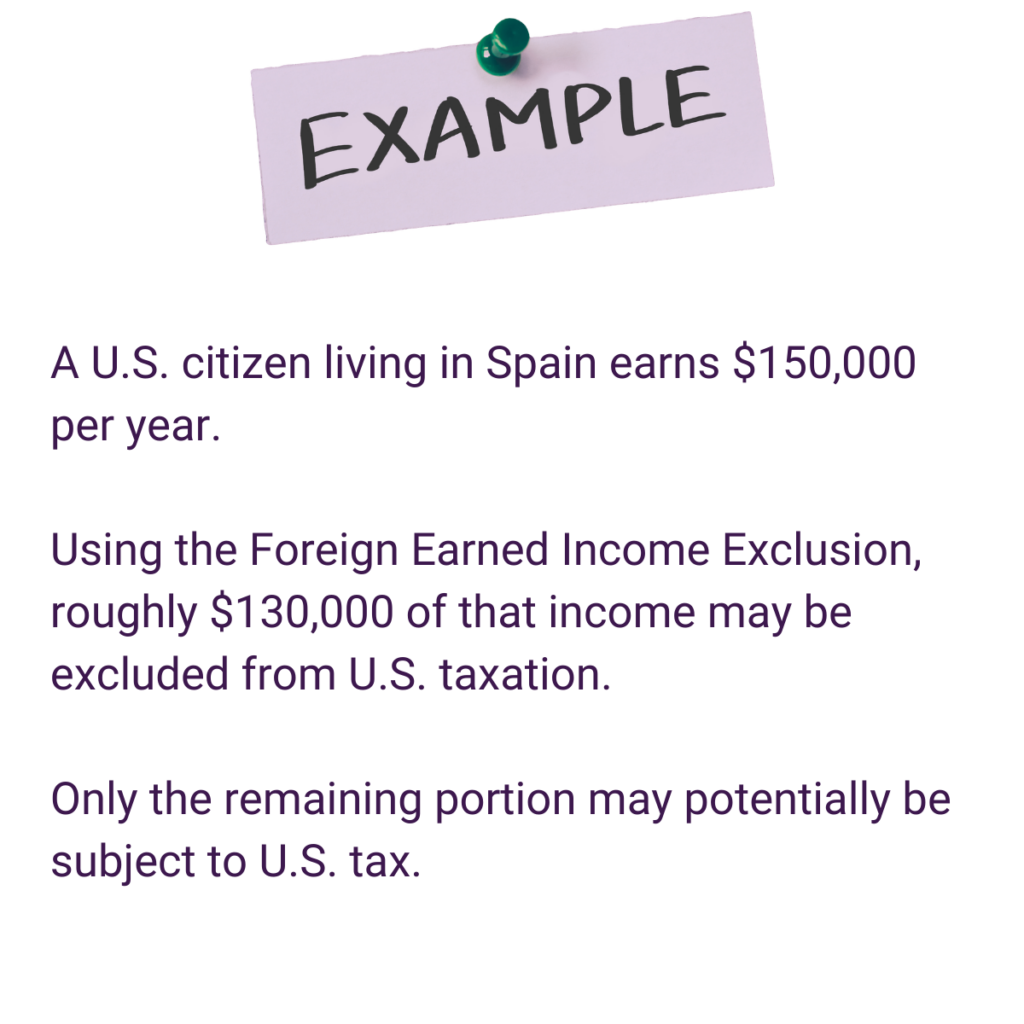
Foreign Earned Income Exclusion (FEIE)
The Foreign Earned Income Exclusion allows qualifying individuals to exclude a significant portion of earned income from U.S. taxation.
In recent years, this exclusion has been approximately $120,000–$130,000 per year, adjusted annually for inflation.
-
Foreign Tax Credits
Another protection is the Foreign Tax Credit.
If a U.S. citizen pays income tax in their country of residence, those taxes can often be used as a credit against U.S. taxes owed.
In many countries with relatively high income taxes, these credits often reduce the U.S. tax obligation to little or nothing.
Additional Reporting Requirements
Even when no tax is owed, Americans living abroad may still have financial reporting obligations.
-
FBAR Reporting
U.S. citizens must file FinCEN Form 114, commonly known as the FBAR, if their foreign bank accounts exceed $10,000 at any time during the year.
This is purely a reporting requirement, not a tax.
-
FATCA Reporting
Under the Foreign Account Tax Compliance Act (FATCA), individuals with significant foreign financial assets may need to file Form 8938 to report those assets to the U.S. government.
Again, these are reporting requirements designed to promote transparency, not additional taxes.

What This Means for Children Born in the United States
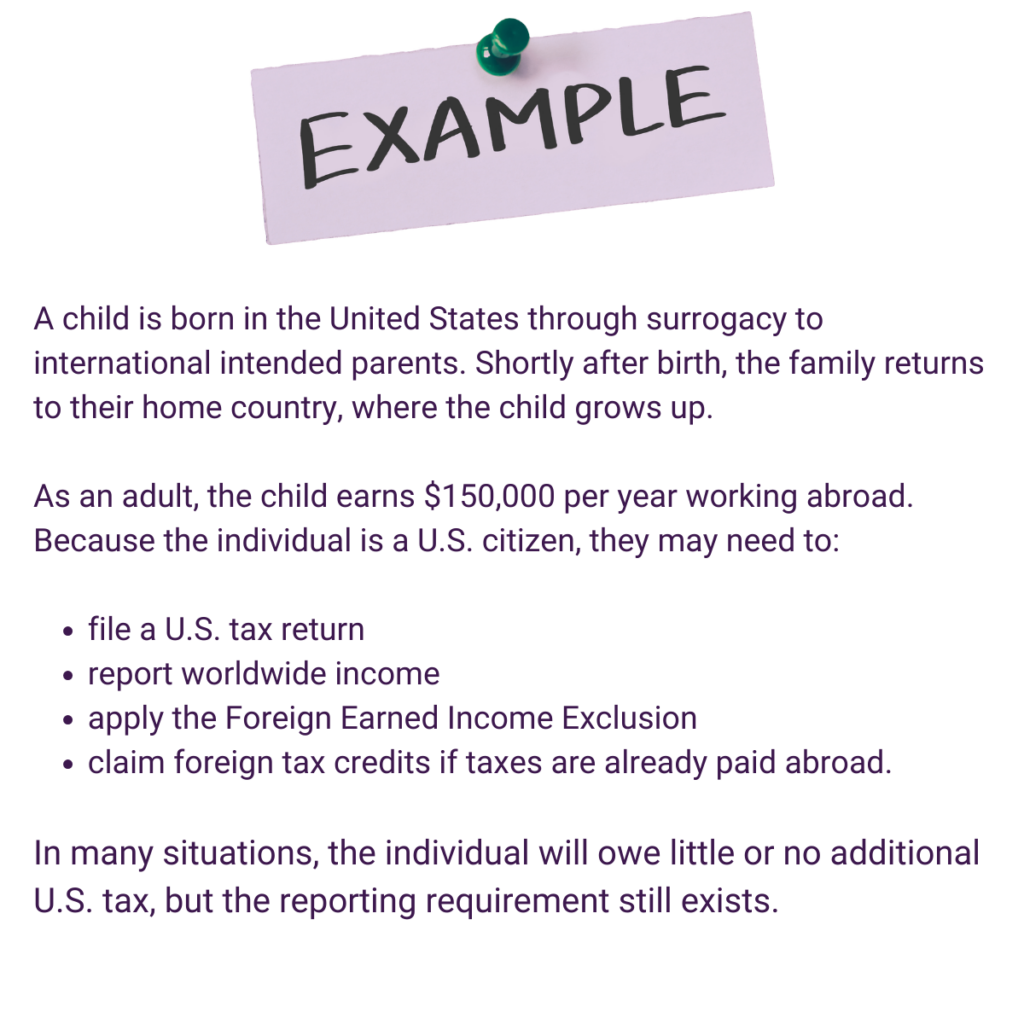
Children born in the United States typically receive U.S. citizenship at birth, regardless of their parents’ nationality.
For international families pursuing surrogacy in the United States, this means the child may have a lifelong connection to the United States, including potential tax filing obligations.
This does not mean the child will necessarily owe taxes. However, a filing requirement may apply if income exceeds the standard thresholds.
Inheritance and Investment Income
Another situation that may arise involves inheritance.
If a U.S. citizen living abroad inherits money or assets from family members in another country, the inheritance itself is generally not taxed as income in the United States.
However, any income generated by those assets, such as dividends, rental income, or capital gains, may need to be reported annually.

Can a Person Renounce U.S. Citizenship?
Once a person reaches adulthood, they may choose to renounce their U.S. citizenship if they decide it no longer suits their circumstances.
However, certain requirements apply:
- The individual must be fully compliant with U.S. tax filings for the previous five years
- High-net-worth individuals may be subject to an exit tax.
Because of these requirements, renunciation should only be considered after careful consultation with financial and legal advisors.
The Advantages of U.S. Surrogacy
Despite these administrative considerations, the United States remains one of the most secure and respected destinations for surrogacy in the world.
Families are drawn to the U.S. because of:
-
- clear and reliable legal frameworks
- experienced surrogacy agencies and attorneys
- world-leading IVF clinics with high success rates
- advanced neonatal care and hospital facilities
- comprehensive medical and psychological screening of surrogates.
For many international intended parents, these factors provide peace of mind during one of the most important journeys of their lives.
Final Thoughts
U.S. citizenship offers significant opportunities, but it also carries certain responsibilities. Understanding the long-term financial implications can help international families make informed decisions when planning their journey.
At the same time, the United States continues to provide one of the safest, most structured, and medically advanced environments for surrogacy anywhere in the world, helping families from around the globe achieve their dream of having a child.
